
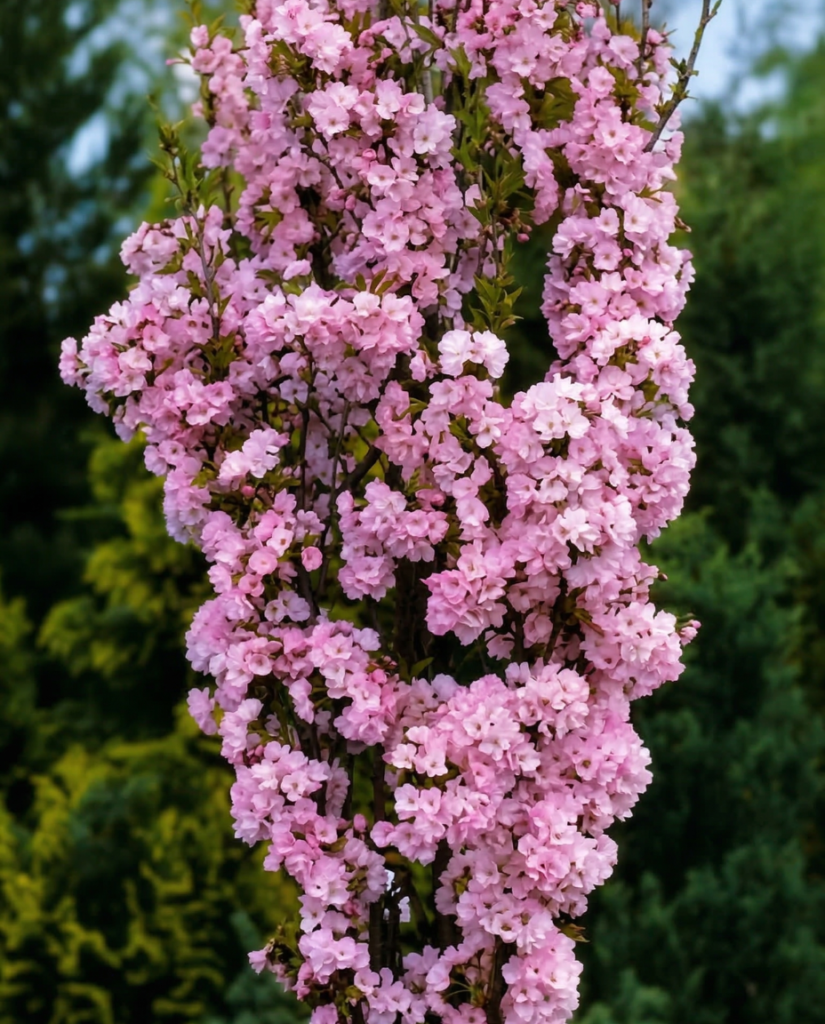
Amanogawa Cherry Blossom
Featured Specimen

Amanogawa Cherry Blossom

Known as the "Flagpole Cherry" or "Milky Way," the Amanogawa Cherry (Prunus serrulata 'Amanogawa') is an elegant, columnar tree perfect for small gardens and narrow spaces.

Botanical Specifications

Scientific Name
Prunus serrulata
Family
Rosaceae
Origin
Japan
Hardiness Zone
USDA Zones 5 - 8
Bloom Timing
Mid-Spring (April)
Conservation Status
Least Concern (Widely cultivated)

Exposure

Full Sun (Requires at least 6 hours of direct sunlight)

Hydration

Full Sun (Requires at least 6 hours of direct sunlight)

Soil pH

6.0 - 7.0 (Slightly acidic to neutral)

Dormancy

Winter

Advantages of Amanogawa Cherry Blossom

The primary advantage of the Amanogawa Cherry (Prunus serrulata ‘Amanogawa’) is its unique columnar growth habit. Known as the “Flagpole Cherry,” its narrow, upright form makes it the perfect choice for small gardens, urban patios, or as a striking vertical accent in tight spaces. Unlike many other ornamental cherries, its shell-pink flowers are delicately fragrant, adding a sensory layer to its visual beauty. Additionally, it offers multi-season interest with its leaves turning vibrant shades of orange and red in the autumn.

Disadvantages of Amanogawa Cherry Blossom

The main disadvantage is its limited shade profile; its narrow canopy provides almost no shade compared to spreading varieties. It is also less wind-resistant due to its tall, thin structure, making it prone to leaning if not protected in very gusty areas. Lastly, while beautiful, its vertical branches can sometimes look sparse if the tree is not grown in full sun, which is essential for maintaining its dense floral clusters.

Frequently Asked Questions

Detailed botanical inquiries regarding the Amanogawa Cherry Blossom cultivar.

How wide does an Amanogawa cherry tree get?

The Amanogawa is famous for its columnar, upright growth habit. While it can reach a height of 15 to 25 feet (4.5 to 7.5 meters), it typically only spreads 4 to 8 feet (1.2 to 2.4 meters) wide, making it perfect for tight spaces.

What do the flowers of the Amanogawa cherry look and smell like?

It produces dense clusters of semi-double, shell-pink flowers that often fade to near-white. Uniquely among many ornamental cherries, the blossoms have a delicate, sweet fragrance.

Does the Amanogawa cherry tree require a lot of pruning?

No, its naturally fastigiate (columnar) shape means it requires very little structural pruning. You only need to remove any dead, damaged, or crossing branches during its winter dormancy to maintain its health and tight form.